
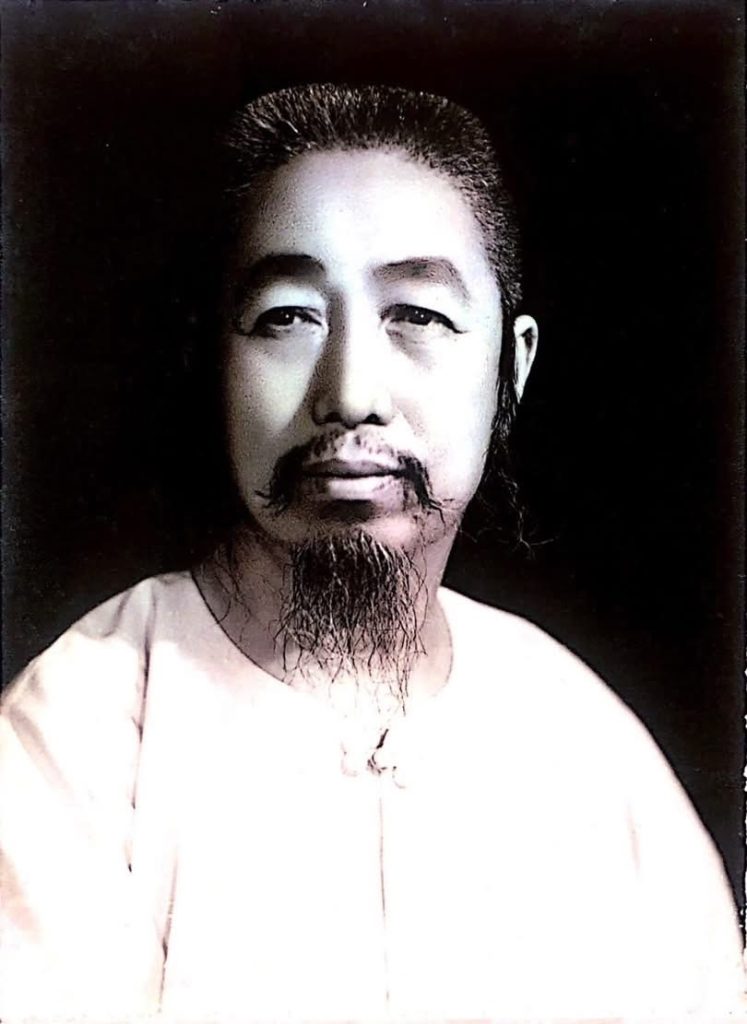
拔根技法如何使之臻於完善 鄭曼青宗師
SamChiu 邱敏祥中譯及註
Uprooting an opponent so that both his feet leave the ground requires a faultless technique. If only his front foot is uprooted, causing it to wheel to the rear, your technique needs improving. Carefully study the six points presented below and apply them when doing the Pushing-Hands Practice. In this way you should be able to overcome any faults of technique.
要將對手拔根, 使其雙腳同時離地, 必須具備毫無缺失的技術。 如果只拔起對方的前腳, 導致其腳向後轉動, 那麼你的技術仍需改進。 請仔細研讀以下提出的六個要點, 並在推手練習中加以運用。 如此一來,你應能克服任何技術上的缺失。
1. Before attacking, you must withdraw slightly, straighten your waist, and use tenacious energy. Your front knee should not extend over the toes of your foot—otherwise your energy will be dispersed. With your shoulders and elbows loose, keep your spine and your head erect. If these things are done, your tenacious energy will be unified and can break down any strong point of your opponent.
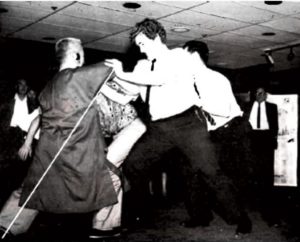
一、在進攻之前,你必須略微回收,伸直腰胯,並運用「彈力」 。你的前膝不應超過腳尖,否則力量將會散失。保持肩、肘放鬆,脊柱與頭部正直。 若能做到這些, 你的韌勁便能統一貫通, 足以瓦解對手任何強點。
註:鄭子太極拳十三篇述口訣曰能發勁,勁由於筋、力由於骨,柔活有彈性是勁。
2. Don’t use too much force when you touch your opponent before attacking. If you do, this will give him a chance to anticipate your attack so that, as you begin it, he can neutralize your weight slightly and you will fail to uproot him.
二、 在進攻之前, 手與對方接觸時, 切勿使用過多力量。 若用力過大,將給對方預判你攻擊的機會, 使其在你開始發勁時, 稍微化解你的重力,從而導致你無法將其拔根。
註:陶炳祥大師要求鬆到底。 「一羽不能加,蠅蟲不能落」的境界。這要靠「鬆」去達成, 「鬆」不僅只是手上容易練出聽勁,拳經上要求的「周身節節貫串,無令絲毫間斷」也都靠「鬆」 。
3. When your hands lightly touch him, you must detect a slight wave of resistance in his body. Taking advantage of this wave, you will be able to attack him decisively. This detection, however, is an ability requiring a long period of study and practice.
三、當你的雙手輕觸對方時,必須察覺其體內出現的一絲抗拒波動。善用這股波動, 你便能果斷地發動攻擊。 然而, 這種覺察能力需要長時間的學習與練習才能培養。
註: 氣由於筋致柔。 有彈力已耳。 惟柔乃能與對手黏連相隨。 能黏連。則我之氣與彼氣相接觸。欲測其氣之動靜。故曰聽。則拳論所謂。彼微動。我先動之機。
4. When attacking, don’t use force with both hands. The T’ai-chi Ch’uan Classics say that in an attack it is necessary to aim at one direction of your opponent. To use force with both hands is technically known as “double weighting” and contradicts the principles of T’ai-chi. The correct way is to attack with one hand while the other simply touches the opponent’s body lightly.
四、進攻時,切勿雙手同時用力。 《十三勢行功心解》指出,發勁須沉著鬆淨、專主一方。雙手同時用力,在技術上稱為「雙重」 ,此舉違背太極拳原理。 正確方法是: 一手發勁進攻, 另一手僅作輕觸對方身體之用。
5. The position of your hands and arms relative to your body beforeattacking should remain the same after attacking. Any disproportionate stretching and contracting of the hands and arms will affect the unified action of the tenacious energy from your leg, and the efficacy of your uproot attack will be greatly decreased.
五、進攻前,雙手與手臂相對於身體的位置,在進攻後應保持不變。若手臂出現不成比例的伸張或收縮, 將影響自腿部而來的韌勁之整體統一運作,並會大幅降低拔根攻擊的效果。
註: 「原體位」是宋志堅大師依鄭宗師「太極不動手」 、 「美人手」提出訓練要點,是手臂局部位置與身體保持相對不動,當身體移動時,手臂隨身體整體移動,確保發勁和接勁時能量能完整地串聯與傳遞,是訓練身體「定」與「貫串」的關鍵。
6. In attacking, you must first withdraw slightly to the rear and downward and then rise, pushing slightly upward, thus uprooting your opponent. The Classics says that if you want to push upward you must first go downward.
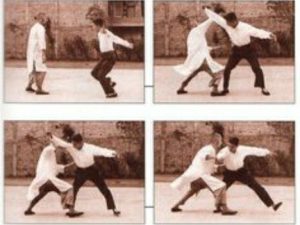
六、進攻時,必須先略微向後、向下收引,然後再上提,向上微微推送,如此才能將對手拔根。 《拳經》云:欲上先下,若要向上推起對方,必須先向下沉 。
註:張三丰祖師太極拳論:如意要向上,即寓下意,若將物掀起而加以挫之之力, 斯其根自斷, 乃攘之速而無疑。 鄭宗師傳干嘯洲大師口訣:略一欠身。
Ti Fang
Ti fang is an action whereby an opponent is caused to lose his root and is then sent flying with the use of minimal force. In order to be effective, ti fang requires precise timing of the neutralization and direction of the push. It should be noted that Cheng Man-ch’ing named the Taiji school on 87 Bowery, New York City, Shi Zhong, which implies appropriate timing, distancing, and direction
提放
「提放」 是一種運用極小力量, 使對手失去根基, 並隨即被送離地面的技術。 要使提放有效, 關鍵在於化勁與推送方向的精準時機。 值得注意的是, 鄭曼青教授將其位於紐約包厘街 87 號的太極拳學校命名為「時中」 ,此名正寓意了正確的時機、距離與方向。
The appropriate timing for your push is at the moment your partner puts weight on his forward foot to pull back from falling forward. The goal is to feel that moment and add your push to your partner’s backward movement. If the push is too late, your partner will have already regained balance and root. If the push is too early, your partner will not have sufficiently lost balance and will be rooted.
推送的適當時機, 是在對方將重量落於前腳、 為了避免向前跌倒而開始向後收回身體的那一瞬間。 修練者的目標, 是覺察這個瞬間, 並順著對方已經產生的後退動勢, 加上自己的按勁。 如果推得太晚, 對方早已恢復平衡並重新生根;如果推得太早,對方尚未充分失去平衡,仍然有根。
The characters (a) ancient, (b) recent, for Shi Zhong, which were used by Professor Cheng Man-ch’ing in naming his Taiji school. The first character, shi, has a symbol on the left representing the sun. In ancient times, the Chinese used a sun dial to know the time. The symbol just to the right of the sun represents a Buddhist temple 寺 , whose bell announced the hour. The symbol for the Buddhist temple has a plant sprouting from the earth and a hand below it, with a horizontal line pointing to the pulse point. The plant suggests upward growth over time, and the pulse also suggests time. The line pointing to the pulse point,which is one inch below the wrist, suggests proper placement.
The second character, zhong, represents a bow and arrow →, suggesting the idea of aiming in the right direction. Thus, the name, Shi Zhong, represents the cultivation of appropriate timing, placement, and direction, which are essential elements in Taiji.
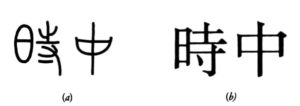
圖中顯示「時中」二字的兩種字形:(a) 古體,(b) 今體,為鄭曼青教授命名其太極拳學校時所使用。第一個字 「時」 , 左側的 象徵太陽。 古人以日晷觀測時間。 太陽右
側的符號代表佛寺, 寺中鐘聲用以報時。 佛寺的符號包含自地而生的植物, 象徵隨時間向上生長; 下方的手與橫線, 指向寸口脈位(腕下一寸) ,暗示正確的位置與時機。植物象徵時間的累積與成長, 脈象亦寓時間之流動。 第二個字 「中」 ,象徵弓與箭,寓意指向正確的方向與目標。因此, 「時中」一名,整體象徵著對正確時機、 正確位置與正確方向的修養, 而這三者正是太極拳中不可或缺的核心要素。
註: 「君子之中庸也,君子而時中」出自《禮記中庸》第二章,意思是君子所以能做到中庸, 是因為他能隨時隨地、 因應情境, 做到恰到好處、不偏不倚,不固執、不偏激,達到「無過無不及」境界,這是君子智慧與德行,與小人那種無知、無忌憚、肆意妄為的「反中庸」行為形成鮮明對比。
註:何謂中定?中即時中,定無常定,不失中定,是為定力,中庸所謂不偏不易,亦即中定之定理也。